AutoMark · Western Sydney University
Engineering a better way to assess code.
- My role
- Backend Lead
- Context
- Final-year team capstone
- When
- July–November 2025
- Core stack
- Python · FastAPI · JavaScript · Docker · AWS
From a code commit
to something a lecturer can use.
97/100capstone result
200concurrent submissions tested
43backend API endpoints
Nominated for
Best Capstone Project.
Built by a team. Backend led by me. Accepted by the sponsor after a live demonstration.
01The problem
The submission is only
the beginning.
Manual grading previously took approximately 15 minutes per submission. The repetitive work was in accepting code, running it, applying grading scripts and getting feedback back to the student.
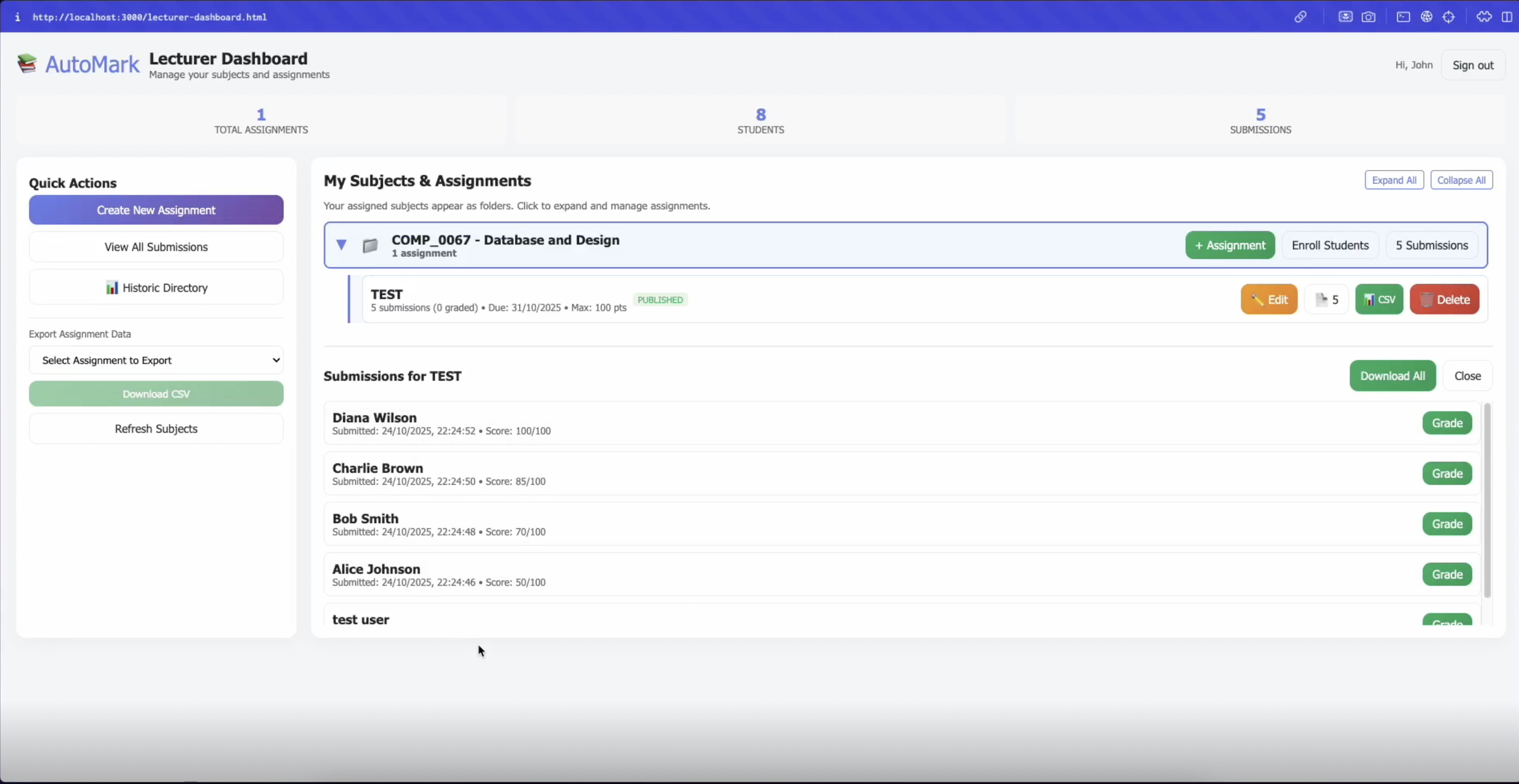
Our WSU capstone team built AutoMark to connect those steps. Students needed a dependable submission path and access to their results; lecturers needed assignment management, grading controls and reporting. The approximate manual time describes the starting problem, not a measured speed-up ratio.
Submit code.
Find the result.
Submit code through SVN, then use the dashboard to access grading results and feedback. The code-submission path and the application need to agree about the work being assessed.
Set up the assessment.
Review the work.
Manage subjects and assignments, track submissions, review grading results and use feedback and reporting through the application.
02What I owned
I built across the workflow.
I served as Backend Lead, with work across the application: core FastAPI services, frontend integrations and distributed grading.
AutoMark was a team delivery. My contribution included developing and integrating dashboard features, alongside the backend and execution workflow; it was not sole ownership of the whole product.
The important work was
in the connections.
Core services & access
I designed and developed FastAPI services for JWT authentication, role-based access, subject enrolment, assignment management and submission tracking. The backend contained 43 API endpoints.
Frontend & API integration
I developed HTML, CSS and JavaScript features connecting student and lecturer dashboards to REST APIs for assignments, file submissions, grading results, feedback and reporting.
Distributed grading
I built the submission-to-feedback workflow, including isolated Docker execution, a durable job queue and independent grading workers on AWS.
03Inside the system
Where does a submission go?
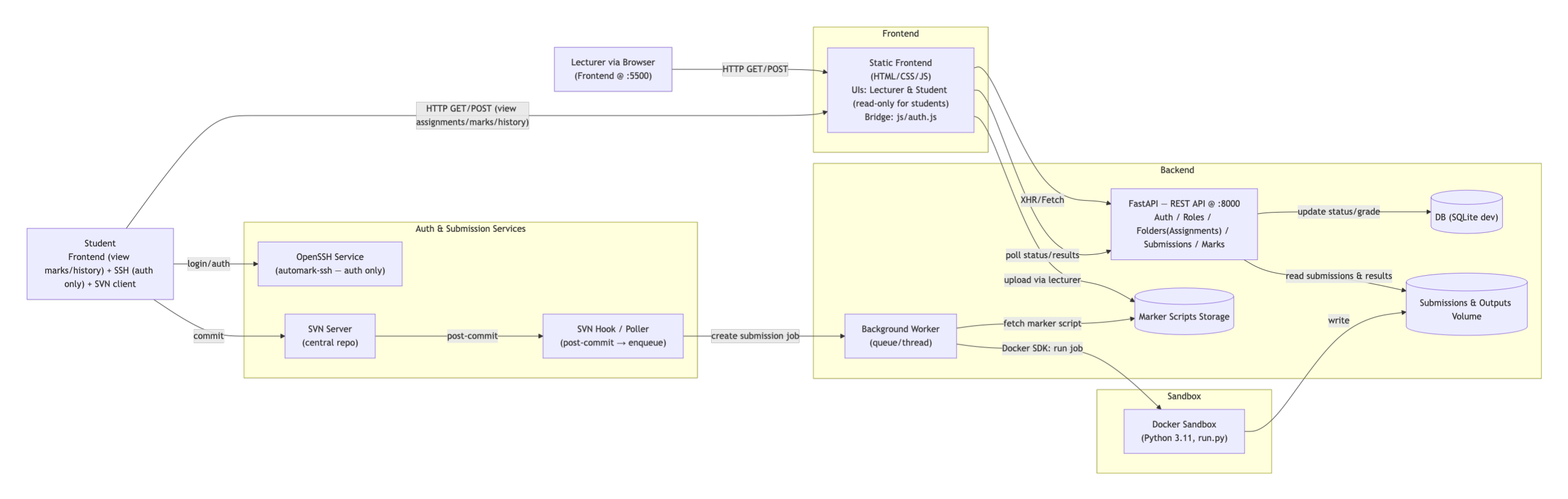
An SVN commit starts the submission path. Intake hands grading work to a durable queue; independent workers on AWS run isolated Docker grading jobs. Application services then make the outcomes useful in the dashboards.
This is a logical view reconciled from the graduate résumé and earlier project drawing. The components are established; exact AWS products, physical boundaries and some handoff protocols are deliberately abstracted.
Submission intake
Student code enters the repository through an SVN commit.Asynchronous grading
Independent workers on AWS execute queued grading work.Application requests & data
Student and lecturer dashboards connect to REST services.Solid lines show the main relationships; dashed lines abstract handoffs and data access. No specific AWS service or transport is implied.
Use pointer, touch, Tab, arrows, Home or End. Read the selected component
SVN
SVN repository
Students submit code by committing it to the SVN repository. The commit is the event; the repository is the service that accepts it.
- In
- A student’s SVN commit containing assignment code.
- Out
- A stored revision and a post-commit event.
The repository accepts the commit; the hook reacts to it. Retrieving marks follows the separate application path.
- To Post-commit hookpost-commit event
Read all connections as text
- SVN repository → Post-commit hookpost-commit event
- Post-commit hook → Submission intakesubmission information · logical relationship
- Submission intake → Durable job queueenqueue grading job · logical relationship
- Durable job queue → AWS grading workersqueued grading work · logical relationship
- AWS grading workers → Docker executionrun grading work
- Docker execution → Results & feedbackscores + feedback · logical relationship
- Results & feedback → FastAPI servicesretrieve outcomes · logical relationship
- Student & lecturer dashboards → FastAPI servicesREST requests / results
- FastAPI services → Records & grading filesapplication data · logical relationship
- Records & grading files → Docker executioncode + script access · logical relationship
A few terms, in plain language
- Post-commit hook
- An action triggered after code is committed to the repository.
- Sandbox
- A separate execution environment for running submitted code.
- Polling
- Asking the service for an updated status or result at intervals.
04Engineering decisions
Accept first. Grade independently.
The main engineering question was how to connect incoming submissions, independent grading and the application people actually use. These choices explain that separation and the responsibilities around it.
01 / Intake & execution
Why keep accepting work separate from grading it?
I implemented a durable queue and independent AWS workers so incoming submissions could be accepted separately from the work of executing student programs and grading scripts.
02 / Isolated execution
Give submitted code its own execution environment.
Student programs and grading scripts ran in isolated Docker containers. The worker coordinates grading work while the container provides the execution environment.
03 / Full-stack integration
Make the outcome usable in the application.
JWT and role-based access sit alongside enrolment, assignment management and submission tracking. I also connected frontend features to the APIs that return results, feedback and reporting data.
05When things did not go to plan
A volume issue, during the demo.
A system includes
its environment.
A Docker volume issue interrupted our demonstration. I investigated, fixed the problem and successfully demonstrated the system afterwards.
The experience reinforced the same lesson as the distributed workflow: the connections matter. Code, scripts, containers and the environment have to work together for the application to produce a useful result.
It is why I want to test the complete path in its target environment, as well as the individual services. The specific root cause and recovery steps are not reconstructed here.
06Verification & results
200 submissions. Every job graded.
In the end-to-end test, all 200 concurrent submissions were accepted and all 200 jobs were graded.
The reported results show what happened in that project test. They do not establish a production workload, sustained throughput or an infrastructure-capacity guarantee.
97/100Capstone result · nominated for Best Capstone Project. The backend contained 43 API endpoints.
Accepted. Then graded.
200 / 200jobs accepted and graded
18.17s
All SVN commits accepted in 18.17 seconds.
This describes intake of the submissions, before considering when each grading job completed.
| Percentile | Time |
|---|---|
| P95 | 155s |
| P99 | 157s |
P95 and P99 mark the completion times below which approximately 95% and 99% of the measurements fell.
Acceptance and completion measure different parts of the workflow. The 18.17-second figure describes acceptance of all SVN commits. P95 and P99 describe grading completion; they are not averages.
The résumé does not define the exact timing origins or test setup. Intake duration is not added to grading completion. Raw logs, workload details and hardware remain to be reconciled.
07Looking back
I learned to look
between the components.
The useful outcome was a complete system: submit code, accept the work, execute grading independently and return something students and lecturers could use.
Leading the backend also took me into frontend integration and the decisions between services. I enjoyed connecting those responsibilities and checking the behaviour across the whole workflow.
The demonstration and concurrency test gave me different kinds of feedback: one exposed an environment dependency, while the other put numbers around the end-to-end workflow. These are the areas I would develop further.
Make the environment reproducible
I would extend clean-environment checks around volume configuration and the complete submission path before a demonstration.
Keep the measurements reproducible
I would keep raw test logs, timing definitions, workload and infrastructure details alongside the reported results so another engineer could repeat the test.